The core mechanics of fishing games
Most fishing games are built around the same loop of casting, waiting, hooking and reeling. This guide walks through each stage so you know what to pay attention to from your first session.
The basic loop
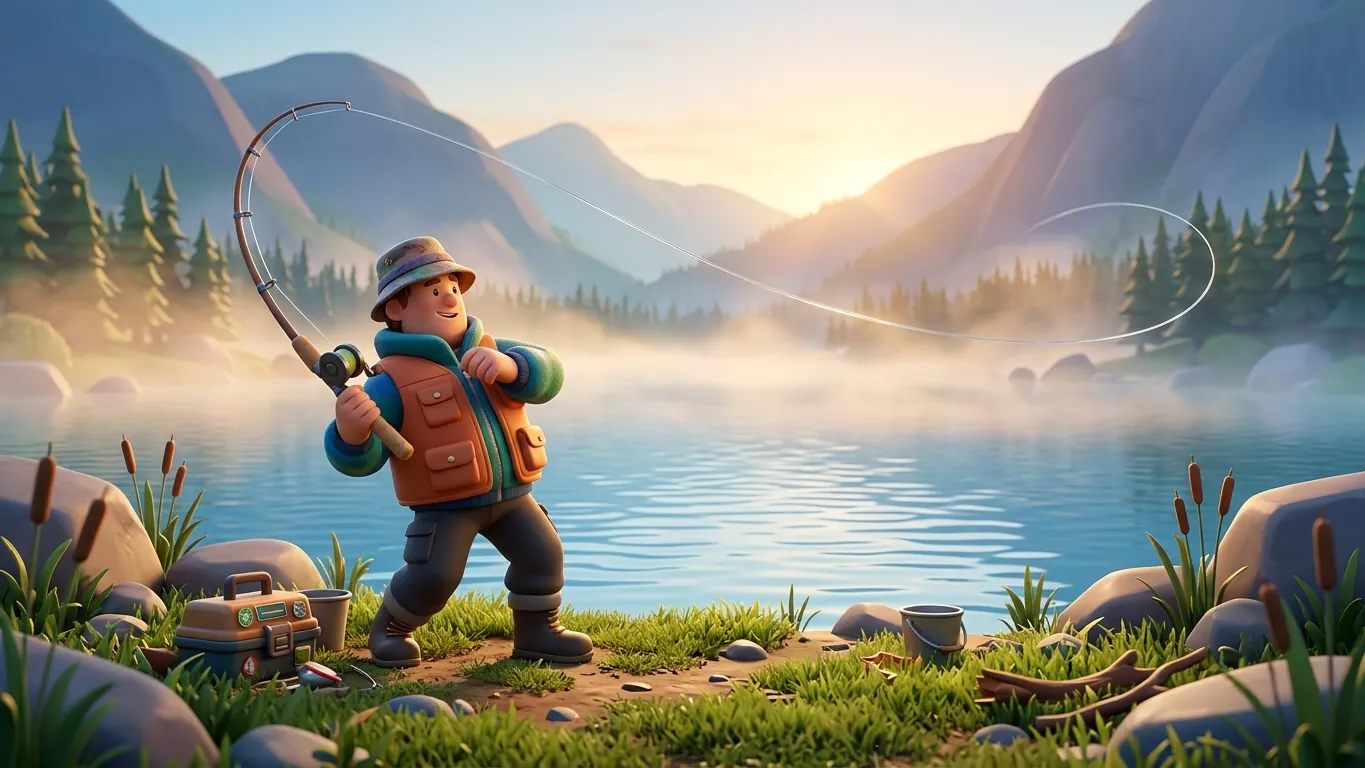
Almost every fishing game, whether it is a relaxed side activity or a dedicated simulation, follows a simple cycle. You choose a spot, cast your line, wait for a fish to show interest, set the hook at the right moment and then bring the fish in without breaking the line. After that, you either keep the catch, release it or record it in some kind of collection, and the cycle begins again.
Understanding this loop helps you focus. When a session feels frustrating, it is usually because one specific stage is going wrong. Maybe your casts land in empty water, maybe you strike too early, or maybe the line keeps snapping during the fight. Breaking the loop into stages lets you fix one problem at a time instead of feeling that the whole game is against you.
Casting: distance and accuracy
Casting is usually controlled by a power meter, a held button or a motion that you release at the right moment. Many games reward accuracy more than raw distance. A long cast into open water may look impressive, but a shorter cast placed next to reeds, rocks or a sunken log often puts your bait where fish are more likely to be.
Take a few minutes early on to learn how your game handles casting. Try short, medium and long casts in the same area and notice how consistent you can be. If the game lets you adjust the cast direction after release or feather the line, practise that as well, because small corrections make a noticeable difference near cover.
The bite and the hookset
Once your bait is in the water, the game will signal interest from a fish. This might be a twitching bobber, a vibration, a sound cue or a visible fish approaching the lure. The key skill here is patience. Many games distinguish between a fish nibbling and a fish committing, and striking too early simply pulls the bait away.
Watch for the clearer signal, such as the bobber being pulled fully under or a stronger vibration, before you set the hook. If you miss several bites in a row, try waiting a fraction longer next time. If fish keep escaping before you react, you may be waiting too long. It takes a few attempts to find the rhythm your particular game expects.
Reeling and the fight
After the hookset, most games switch to a fight phase. Usually there is some form of line tension to manage. Reel too hard while the fish is pulling and the line may snap; reel too gently and the fish may slip free or tire you out. Larger or rarer fish tend to pull harder and change direction more often.
A reliable habit is to ease off when the fish runs and reel steadily when it pauses or swims toward you. Some games also let you steer the rod left or right to counter the fish's direction. We go deeper into this topic in our article on line tension, but even this simple approach will help you land more catches.
Progression and collections
Many fishing games give you long-term goals beyond each individual catch. You might fill out a catalogue of species, unlock new locations, upgrade rods and reels, or complete requests from characters in the game world. These systems give structure to what could otherwise be an endless, open-ended activity.
It is worth checking which goals actually matter to you. Some players enjoy completing every collection entry, while others simply like the calm of sitting by the water. Neither approach is wrong. If progression starts to feel like a chore, it is perfectly fine to slow down and play at a pace that keeps the experience enjoyable.
Related articles
 Reading the water in fishing games
Learn how fishing games signal where fish gather, from shoreline structure and depth to weather and time of day, so your casts land in better spots.
Read more
 Picking the right lure or bait
A practical look at lure and bait choices in fishing video games, covering colour, depth, retrieve speed and how to experiment when fish ignore you.
Read more
 Managing line tension during the fight
Understand how line tension works in fishing video games and learn calm, practical habits for reeling in larger fish without snapping the line.
Read more